
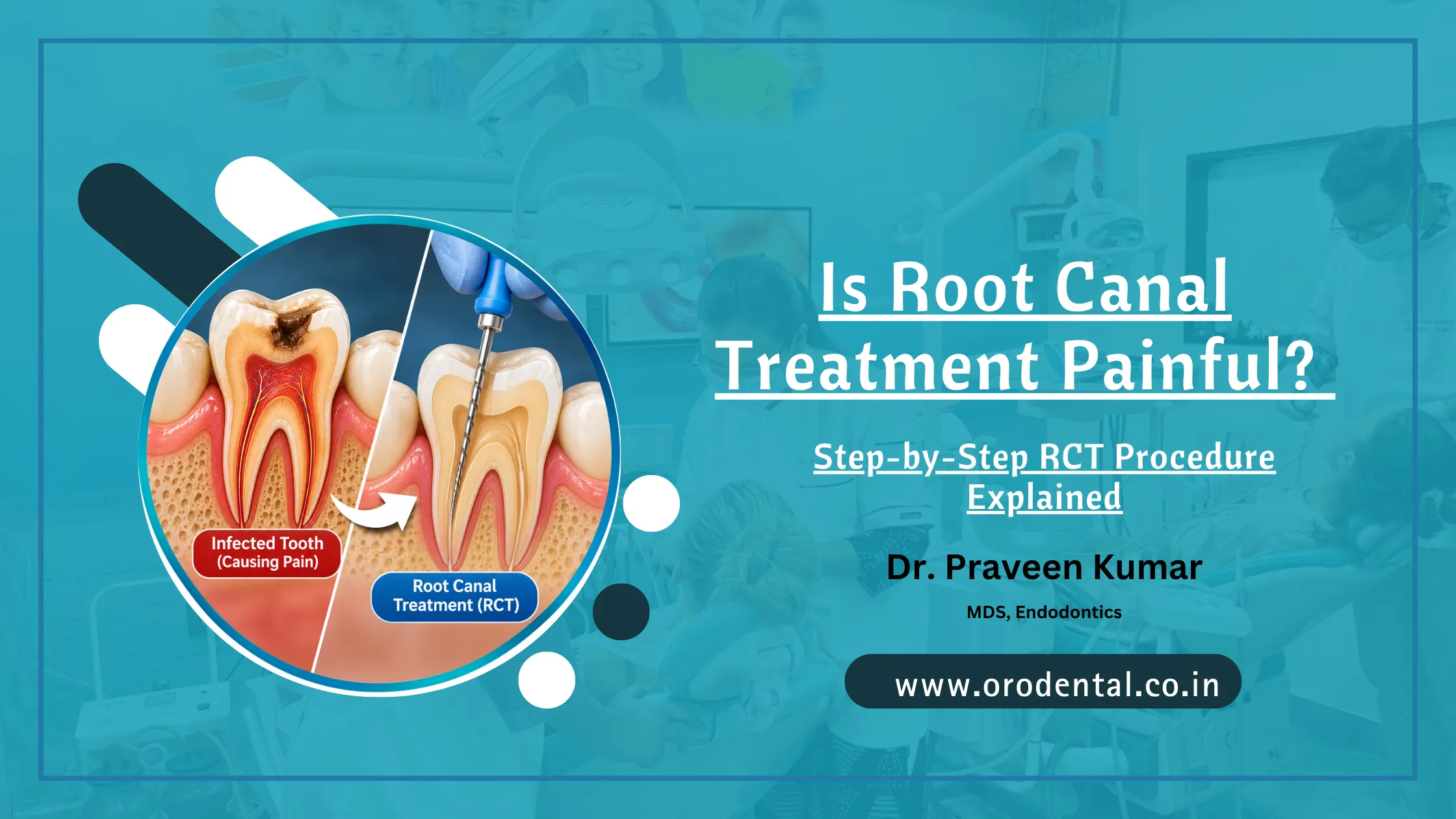
Is Root Canal Treatment Painful? Step-by-Step RCT Procedure Explained
Is root canal treatment painful? No — modern root canal treatment is not painful. With advanced local anaesthesia and digital dental technology, most patients feel little more than mild pressure during the procedure. The pain you feel before a root canal — from an infected or abscessed tooth — is far more intense than the treatment itself. At Oro Dental Clinic in Lanka, Varanasi, root canal procedures are performed by Dr. Praveen Kumar, MDS Endodontist, using precision instruments and a patient-first approach designed to minimise discomfort at every step.
Is Root Canal Treatment Painful?
This is the most searched dental question in India — and the fear behind it stops thousands of patients from getting treatment they genuinely need.
Let’s answer it directly: root canal treatment (RCT) today is not the painful procedure it was 20 years ago.
Modern endodontics uses powerful local anaesthesia, ultrafine instruments, and digital imaging to make the procedure controlled, precise, and significantly more comfortable than the toothache or infection that sends patients to the clinic in the first place.
The sharp, throbbing pain of a nerve-infected tooth is what root canal treatment eliminates — not what it causes.
That said, every patient’s situation is different. Teeth with severe infections or reduced pulp vitality may require additional anaesthesia or a phased approach. A good endodontist will assess this honestly and adjust the plan accordingly.
If you have been told you need a Root Canal Treatment in Varanasi and you are nervous about pain, the right step is a proper clinical assessment — not delay.
Signs You May Need Root Canal Treatment
Your body often signals a tooth problem well before it becomes an emergency. Watch for these warning signs:
Pain and Sensitivity
- Severe, persistent toothache — especially when biting or applying pressure
- Prolonged sensitivity to hot or cold that doesn’t go away after the stimulus is removed
- Sharp pain that radiates from one tooth to your jaw, ear, or temple
Visible Changes
- Darkening or discolouration of a tooth
- A small pimple-like bump (dental abscess or sinus tract) on the gum near the affected tooth
- Swelling of the gum, jaw, or face
Other Signals
- A tooth that was previously treated or filled but now hurts again
- A cracked or broken tooth with deep pain
- Persistent bad taste or odour from one area of the mouth
None of these symptoms should be ignored. Dental infections do not resolve on their own — they worsen over time and can spread. If you are experiencing any of the above, contact an Emergency Dentist in Varanasi as soon as possible.
Step-by-Step RCT Procedure at Oro Dental Clinic
Understanding exactly what happens during a root canal helps remove the fear. Here is what the process looks like at Oro Dental Clinic, performed by Dr. Praveen Kumar, MDS Endodontist:
Step 1 — Diagnosis and Digital Imaging
Before any treatment begins, the tooth is carefully evaluated. At Oro Dental Clinic, this includes digital dental X-ray or CBCT imaging when needed, giving Dr. Kumar a precise three-dimensional view of the root anatomy, infection extent, and surrounding bone.
This accuracy matters: every root canal is different. Some teeth have one root; molars may have three or more. A thorough diagnosis prevents surprises during treatment and allows for a more predictable, comfortable outcome.
Step 2 — Local Anaesthesia
The area around the affected tooth is numbed using a local anaesthetic injection. Modern anaesthetic agents work quickly and effectively. For most patients, the sensation during the procedure is limited to pressure — not pain.
Patients who are anxious or who have highly sensitive teeth can discuss additional comfort options with Dr. Kumar during their consultation.
Step 3 — Dental Dam Placement
A thin rubber sheet called a dental dam is placed around the tooth. This isolates the treatment area, keeps it dry, and prevents bacteria from the saliva entering the root canal during the procedure. It is a standard part of proper endodontic practice.
Step 4 — Access Opening
A small opening is made through the crown of the tooth to reach the pulp chamber beneath. The pulp — the soft tissue containing nerves and blood vessels — is what needs to be removed when it becomes infected or irreversibly damaged.
Step 5 — Pulp Removal and Canal Cleaning
Using precision endodontic files, the infected or damaged pulp tissue is carefully removed from each root canal. The canals are then shaped, cleaned, and disinfected using antimicrobial irrigants. This step eliminates the bacteria causing the infection.
This is the core of root canal treatment — and with proper anaesthesia in place, most patients do not experience pain during this stage.
Step 6 — Canal Filling (Obturation)
Once the canals are clean, dry, and shaped, they are filled with a biocompatible material called gutta-percha, along with a sealing cement. This fills the entire root canal space, preventing future bacterial entry and sealing the tooth from inside.
Step 7 — Temporary or Permanent Restoration
After the root canal is complete, the access opening is sealed with a temporary or permanent filling. In most cases, the tooth will then require a crown — especially if it is a molar or premolar that takes significant biting load.
A Dental Crown Treatment is an important final step in root canal therapy. Without a crown, a root-canal-treated tooth is structurally weaker and more prone to fracture over time.
Single Sitting vs Multiple Sitting Root Canal — Which Is Right for You?
Both single-sitting and multiple-sitting root canal treatments are clinically valid. The choice depends on the clinical condition of the tooth, the complexity of the root anatomy, and the extent of infection.
| Factor | Single Sitting RCT | Multiple Sitting RCT |
| Sessions Required | 1 appointment | 2–3 appointments |
| Ideal For | Non-infected or mildly infected teeth, simple root anatomy | Severely infected teeth, complex root anatomy, active abscess |
| Procedure Time | 60–90 minutes | 45–60 minutes per visit |
| Intracanal Medication | Not required | Calcium hydroxide placed between visits |
| Patient Comfort | Completed in one visit — fewer visits, less anxiety | Gradual resolution of infection before final filling |
| Restoration | Crown placed shortly after | Crown placed after all sessions complete |
| Clinical Suitability | Determined by Dr. Kumar after diagnosis | Determined by Dr. Kumar after diagnosis |
Important: The decision between single-sitting and multiple-sitting RCT is a clinical one — not a preference one. At Oro Dental Clinic, Dr. Praveen Kumar will advise you on which approach is appropriate based on the actual condition of your tooth after examination and imaging.
Crown After Root Canal — Why It Matters
A root canal-treated tooth is structurally different from a healthy tooth. The pulp has been removed, and over time, the tooth can become more brittle. This is why placing a dental crown after root canal treatment is strongly recommended in most cases.
A crown:
- Restores the natural shape and appearance of the tooth
- Protects it from fracture during chewing
- Seals the tooth completely to prevent re-infection
- Significantly extends the functional life of the treated tooth
Without a crown, there is a meaningful risk of the tooth cracking — which could lead to extraction. Skipping the crown to save cost is a decision that often results in a larger expense later.
At Oro Dental Clinic, Dr. Kumar will advise you on the right type of crown for your tooth — ceramic, PFM, or zirconia — based on the location and function of the tooth. Learn more about Dental Crown Treatment at the clinic.
Root Canal Recovery Time and Aftercare
Recovery after a root canal is typically straightforward. Here is what to expect:
In the first 24–48 hours:
- Mild soreness around the treated tooth is normal, particularly after the anaesthesia wears off
- Over-the-counter pain relief (as advised by your dentist) is usually sufficient
- Avoid chewing hard or sticky foods on the treated side
General aftercare guidance:
- Maintain your regular oral hygiene routine — brush twice daily, floss carefully
- Avoid very hot or very cold foods for a day or two
- If a temporary filling is placed, be careful not to dislodge it
- Attend your scheduled follow-up for crown placement
- Contact the clinic if swelling, severe pain, or the temporary filling dislodges
Root canal recovery time: Most patients return to normal activity within a day. The tooth may feel slightly sensitive for a few days, but significant pain post-treatment — if it occurs — should be reported to your dentist promptly.
Root canal treatment aftercare is straightforward when you follow your dentist’s guidance and proceed with the crown as planned.
According to the American Dental Association (MouthHealthy){:rel=”nofollow” target=”_blank”}, root canal treatment has a high success rate and can preserve a natural tooth for many years when properly restored and maintained.
Why Choose Oro Dental Clinic for Root Canal Treatment in Varanasi?
Led by an MDS Endodontist
Meet Dr. Praveen Kumar — BDS (MU), MDS – Endodontics (Lucknow). Root canal treatment is not just a service at Oro Dental Clinic — it is Dr. Kumar’s specialisation. MDS in Endodontics means postgraduate-level training specifically in root canal procedures, pulp biology, and complex case management.
Purvanchal’s First Fully Digital Dental Clinic
Oro Dental Clinic uses digital X-rays, CBCT imaging, and a 3D Intraoral Scanner for precise diagnosis before treatment begins. This level of imaging accuracy supports better case planning, fewer complications, and a more predictable outcome.
Precision Instruments, Not Guesswork
Modern endodontic instruments, including rotary files and electronic apex locators, are used to clean and shape root canals accurately. This reduces procedure time and improves the quality of canal preparation.
A Genuinely Comfortable Environment
The clinic is designed around patient comfort — from the consultation experience to post-treatment support. Dental anxiety is acknowledged and addressed, not dismissed.
Transparently Ethical Practice
No unnecessary treatment recommendations. No inflated pricing surprises. Dr. Kumar will advise you honestly on whether RCT is appropriate for your tooth or whether another course of action — such as extraction — might be more suitable in your specific situation.
Frequently Asked Questions About Root Canal Treatment
Is root canal treatment really painless?
Most patients find that root canal treatment is significantly less uncomfortable than expected. With effective local anaesthesia, the procedure itself involves pressure and sensation but not the sharp pain commonly feared. Some soreness after treatment is normal and temporary. We cannot guarantee a completely pain-free experience for every patient — tooth condition and individual response vary — but our approach is specifically designed to minimise discomfort.
How many sittings does a root canal take?
It depends on the clinical condition of your tooth. Single-sitting root canals are possible for teeth with no active infection and straightforward anatomy, completing in one appointment of about 60–90 minutes. Severely infected teeth or complex root anatomy may require two to three sittings. Dr. Praveen Kumar will assess your tooth and recommend the appropriate number of visits after examination.
Can a tooth be saved with root canal treatment?
Yes — root canal treatment exists specifically to save a natural tooth that would otherwise need extraction. A successfully treated and properly crowned tooth can last for many years with normal oral care. Preserving your natural tooth is almost always preferable to extraction and replacement.
What happens if I delay root canal treatment?
Delaying treatment for a tooth that needs a root canal allows the infection to progress. It can spread to surrounding bone, adjacent teeth, and in severe cases, beyond the jaw. Dental infections do not heal without treatment. Early intervention is simpler, less expensive, and associated with better outcomes.
Is a crown necessary after every root canal?
Not in every single case — but in most cases, yes. Front teeth (incisors, canines) with minimal tooth structure loss may sometimes be restored with a filling alone. Molars and premolars, which bear significant biting forces, almost always require a crown after root canal treatment to prevent fracture. Dr. Kumar will advise you based on your specific tooth.
What is the cost of root canal treatment in Varanasi?
Root canal treatment costs vary depending on the tooth (front teeth, premolars, molars), the number of roots, the complexity of the case, and whether a crown is required. We recommend booking a consultation at Oro Dental Clinic for an accurate assessment and transparent cost discussion. There are no hidden fees.
Conclusion
Root canal treatment has been misrepresented for decades as a painful, dreaded procedure. The reality in modern dental practice is quite different — it is a precise, well-anaesthetised, and often straightforward procedure that relieves pain rather than causing it.
The fear of RCT causes far more harm than the treatment itself. Patients who delay or avoid treatment risk more complex infections, tooth loss, and significantly higher treatment costs down the line.
If you have tooth pain, prolonged sensitivity, or have been advised that you need a root canal, the most important step is an honest assessment by a qualified specialist.
🦷 Tooth Pain? Get It Checked!
Book your Root Canal consultation at Oro Dental Clinic, Lanka, Varanasi
📞 Call or WhatsApp: +91 9935614326
📞 Alternate: +91 8840870071
🌐 Website: orodental.co.in
📍 Address: B 30/2-10, near Ravidas Gate, Prafulla Nagar Colony, Lanka, Varanasi – 221005
Mon–Sat: 10:00 AM – 8:30 PM | Sunday: 11:00 AM – 2:00 PM (By Appointment)
