
Dental Implants in Varanasi: Cost, Procedure & Why Timing Matters
A missing tooth is rarely just a cosmetic concern. It affects how you chew, how you speak, how your remaining teeth sit — and over time, it can change the shape of your jawbone in ways that are difficult to reverse. For many patients in Varanasi, dental implants have become the most reliable long-term solution for replacing a missing tooth and restoring normal dental function.
If you’re considering dental implants in Varanasi and have questions about cost, how the procedure works, whether you’ve waited too long, or simply where to start — this guide covers everything you need to know before booking a consultation.
What Are Dental Implants?
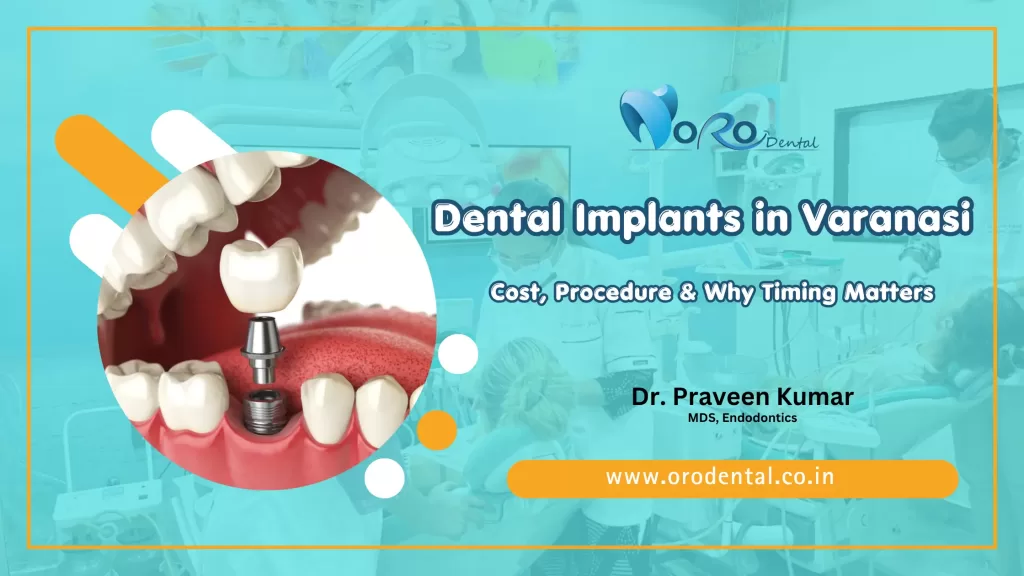
A dental implant is a small titanium fixture — roughly the size and shape of a screw — that is surgically placed into the jawbone to replace the root of a missing tooth. Once it integrates with the bone, a connector piece called an abutment is attached, followed by a custom-made dental crown that looks and functions like a natural tooth.
The result is a tooth replacement that is fixed (not removable), stable, and designed to function like your original tooth. Unlike a bridge, which relies on neighbouring teeth for support, an implant is entirely self-supporting within the jawbone.
Why Are Dental Implants Used for Missing Teeth?
When a tooth is lost — whether through decay, injury, gum disease, or extraction — the jawbone beneath it gradually begins to lose density because it no longer receives stimulation from a tooth root. This process is called bone resorption, and it can begin within months of a tooth being lost.
Dental implants are the only tooth replacement option that directly addresses this problem. By replacing the root, an implant provides the stimulation the jawbone needs to maintain its density and shape. This is why implants are widely considered the closest functional equivalent to a natural tooth.
Dental Implant Procedure — Step by Step
The timeline and steps vary from patient to patient, but here is how the process typically unfolds:
Step 1: Consultation
Your dentist begins with a detailed discussion of your dental history, health conditions, concerns, and treatment goals. This conversation is as important as any scan — it helps build a treatment plan suited to your specific situation.
Step 2: Dental Examination
A thorough clinical examination of your teeth, gums, bite, and the gap area is carried out. The condition of the surrounding teeth and gum tissue plays an important role in deciding whether implant placement is appropriate.
Step 3: CBCT / Dental Imaging When Required
For implant planning, CBCT and dental imaging is often recommended. A Cone Beam Computed Tomography (CBCT) scan provides a detailed 3D view of the jawbone — showing bone height, width, density, and the position of nerves and sinuses. This allows precise planning of implant placement and helps avoid complications. At Oro Dental Clinic, CBCT technology is available in-house for accurate, same-visit imaging.
Step 4: Implant Placement
The titanium implant fixture is surgically placed into the jawbone under local anaesthesia. In straightforward cases, this is a relatively short procedure. In some situations — for example, where bone volume is insufficient — a bone grafting procedure may be recommended before or at the time of implant placement.
Step 5: Healing and Osseointegration
This is the most time-intensive part of the process. Over several weeks to months, the implant gradually fuses with the surrounding bone — a process called osseointegration. The healing duration varies based on the patient’s bone health, overall health, and whether any additional procedures were needed.
Step 6: Abutment and Crown Placement
Once the implant has integrated successfully, the abutment is attached and impressions or digital scans are taken to fabricate your custom crown. The crown is matched to the shape, size, and colour of your surrounding teeth for a natural appearance.
How Much Do Dental Implants Cost in Varanasi?
Dental implant cost in Varanasi varies significantly from patient to patient. There is no single price that applies to every case, because the final cost depends on multiple clinical factors that can only be determined after a proper examination.
Factors that influence the overall cost include:
- Number of implants — single tooth or multiple
- Implant system and brand — different implant systems vary in quality, warranty, and longevity
- Crown material — zirconia, porcelain-fused-to-metal, and other materials differ in cost and aesthetics
- Bone condition — if bone grafting is required, this adds to the overall treatment plan
- Gum health — gum disease may need to be treated before implant placement
- Diagnostic imaging — CBCT scans and other imaging may be needed for accurate planning
- Complexity of the case — immediate implants after extraction differ from cases where healing time has elapsed
- Additional procedures — sinus lifts, ridge augmentation, or other preparatory steps where clinically indicated
Any quote given without a proper clinical examination is unreliable. At Oro Dental Clinic, patients receive a detailed, personalised treatment estimate after a thorough in-person assessment — so you understand exactly what is involved and why.
Why Does Timing Matter for Dental Implants?
The timing of implant placement is one of the most important — and most overlooked — factors in treatment planning. It is not as simple as “the sooner the better” or “it’s too late now.”
Several clinical factors influence the right time for your implant:
- Recent tooth extraction — In some cases, an implant can be placed immediately or shortly after extraction. In others, a healing period is needed first. This depends on the condition of the socket, the presence of infection, and bone availability.
- Active infection — If infection is present in the extraction site or surrounding bone, it needs to be fully resolved before an implant is placed. Placing an implant into an infected site can compromise its success.
- Gum condition — Healthy gums are essential. Active gum disease must be treated and stabilised before implant treatment begins.
- Bone availability — The jawbone must have adequate height, width, and density to hold an implant securely. If bone has been lost, a bone grafting procedure may be needed to rebuild the site before placement.
- Overall oral health — The health of surrounding teeth and the bite are factored into the treatment plan.
Timing is decided case by case — not by a general rule. A proper clinical assessment and dental imaging are the only reliable way to determine the right timing for your specific situation.
What Happens If You Delay Replacing a Missing Tooth?
Delaying treatment is a common decision — and an understandable one. However, the longer a tooth remains missing without replacement, the more changes may occur in the surrounding area:
- Bone volume reduces — the jawbone in the missing tooth area gradually loses density without stimulation from a tooth root
- Neighbouring teeth may shift — adjacent teeth can slowly drift toward the gap over time, affecting alignment and bite
- Opposing teeth may over-erupt — the tooth opposite the gap can begin to grow longer without a tooth to meet
- Chewing patterns may change — patients often unconsciously favour one side, which can affect the jaw joint over time
- Treatment complexity may increase — in some cases, bone loss or tooth movement may require additional steps before an implant can be placed
These are not guaranteed outcomes, and the rate at which they occur varies between individuals. The main point is that an early evaluation is almost always easier than a delayed one.
Can You Get a Dental Implant After Years of Missing a Tooth?
Yes — in many cases, dental implants are still possible even after a tooth has been missing for several years. A missing tooth for a long period does not automatically disqualify someone from implant treatment.
However, the evaluation becomes more important. The bone in the area may have reduced in volume over time, and a CBCT scan is usually essential to assess exactly how much bone remains and whether bone grafting will be needed before placement.
The honest answer is: it depends on your individual bone and gum condition. The only reliable way to find out is a proper examination and imaging assessment.
Is CBCT Needed Before Dental Implant Treatment?
Not in every single case — but it is recommended in most implant cases because it provides information that a regular 2D X-ray cannot.
A CBCT scan gives your dentist a precise 3D view of:
- Bone height and width at the implant site
- Bone density
- Exact position of the inferior alveolar nerve (to avoid nerve damage)
- Proximity to the sinus cavity (for upper jaw implants)
- Root positions of neighbouring teeth
This level of detail allows for accurate implant positioning, appropriate implant size selection, and anticipation of any complications — before the procedure begins. At Oro Dental Clinic, CBCT imaging is available as part of the implant planning process.
Dental Implant vs Bridge vs Denture
| Feature | Dental Implant | Dental Bridge | Removable Denture |
| Bone preservation | Yes | No | No |
| Adjacent teeth affected | No | Yes (trimmed) | No |
| Feels like natural tooth | Most closely | Reasonably | Less so |
| Removable | No | No | Yes |
| Longevity | Long-term with care | Medium-term | Needs periodic replacement |
| Maintenance | Normal brushing/flossing | Special flossing | Daily removal and cleaning |
A crown and bridge is a proven and reliable option for many patients — particularly where implants are not suitable. The right choice depends on your specific clinical situation, which a dentist should help you evaluate. There is no universally “best” option — only the most appropriate option for your case.
How Long Does Dental Implant Treatment Take?
Treatment duration varies considerably. Simple, straightforward cases — where adequate bone is present and no additional procedures are needed — can be completed over a few months. Cases involving bone grafting, multiple implants, or complex healing requirements take longer.
A rough general framework, subject to individual variation:
- Initial consultation and imaging: One to two visits
- Implant placement: Single appointment (for straightforward cases)
- Osseointegration healing: Several weeks to several months depending on the patient
- Crown placement: One to two appointments after healing is confirmed
Your dentist will give you a realistic timeline based on your specific case after examination.
Is Dental Implant Treatment Painful?
Implant placement is performed under local anaesthesia, so the procedure itself should not be painful. Most patients report feeling pressure and movement but not sharp pain during the procedure.
Some discomfort, swelling, and tenderness in the days following placement is normal and typically manageable. Your dentist will advise you on appropriate post-operative care and pain management.
Patients who are anxious about dental procedures often find the experience more manageable than anticipated, particularly in a calm, well-equipped clinical environment. What cannot be claimed is that every patient’s experience is identical — responses to any dental procedure vary individually.
Who Can Get Dental Implants?
Most healthy adults with adequate bone and healthy gums are candidates for dental implants. However, certain conditions need to be evaluated:
- Bone volume — sufficient bone must be present or created through grafting
- Gum health — active gum disease must be treated first
- Systemic health — conditions like uncontrolled diabetes, blood clotting disorders, or certain medications may affect healing and need to be discussed with your dentist
- Smoking — smoking can affect healing and implant success rates; this needs to be disclosed
- Age — implants are generally not placed in patients whose jawbone is still developing
The only definitive way to determine whether you are a suitable candidate is a proper clinical examination. A general answer of “yes” or “no” without an examination is not reliable.
Dental Implant Consultation in Varanasi
Oro Dental Clinic in Lanka, Varanasi offers dental implant consultations led by Dr. Praveen Kumar (BDS, MDS – Endodontics, Lucknow) — an experienced endodontist with a focus on accurate diagnosis, transparent treatment planning, and patient-first care.
The clinic is equipped with in-house CBCT and dental imaging technology, which allows for precise implant assessment and planning in a single visit. All treatment options — including implant, crown and bridge, and other alternatives — are discussed openly so patients can make informed decisions.
For patients who have delayed replacing a missing tooth and are wondering whether it is still possible, a consultation is the first and most important step.
📍 Lanka, Varanasi – 221005 📞 +91 9935614326 / +91 8840870071 🕒 Mon–Sat: 10:00 AM – 8:30 PM | Sun: 11:00 AM – 2:00 PM (by appointment)
Frequently Asked Questions
How much do dental implants cost in Varanasi?
Dental implant cost in Varanasi depends on several factors — number of implants, implant system, crown material, bone condition, and whether additional procedures like bone grafting are needed. A personalised cost estimate is only possible after a proper clinical examination and imaging assessment. Contact Oro Dental Clinic for a consultation.
How long does dental implant treatment take?
Treatment duration varies by case. Straightforward single-implant cases typically take several months from placement to crown fitting, with the majority of that time being the osseointegration healing period. Complex cases requiring bone grafting take longer. Your dentist will give a realistic timeline after assessment.
Is dental implant treatment painful?
The surgical procedure is performed under local anaesthesia, so it should not be painful during the appointment. Some discomfort and swelling in the days following placement is normal and typically manageable. Most patients find the experience more comfortable than anticipated.
When is the best time to get a dental implant after tooth extraction?
Timing depends on several factors including socket healing, presence of infection, and bone condition. In some cases, immediate or early placement is appropriate. In others, a healing period is needed first. Your dentist will recommend the right timing based on examination and imaging.
Can I get a dental implant after years of missing a tooth?
Yes, in many cases. However, the bone in the missing tooth area may have reduced over time, so a CBCT scan is usually needed to assess bone volume. Bone grafting may be required before implant placement. An evaluation will give you a clear, honest answer.
Is CBCT required for all dental implants?
Not universally mandatory, but it is recommended in most implant cases because it provides a 3D view of bone height, width, nerve position, and sinus proximity — information that a regular X-ray cannot provide. This helps ensure safe and accurate implant placement.
Are dental implants better than dentures?
Implants preserve the jawbone, are fixed in place, and function closest to natural teeth. Dentures are removable and do not prevent bone loss. However, the right choice depends on your individual clinical situation — both are valid options depending on the patient’s bone health, number of missing teeth, and overall oral condition.
How long do dental implants last?
With proper oral hygiene and regular dental check-ups, dental implants can function well for many years. Individual outcomes depend on oral hygiene, bone health, systemic health, and lifestyle factors like smoking. No specific duration can be guaranteed for every patient.
What happens if I delay getting a dental implant?
Delaying tooth replacement can allow the jawbone in the area to reduce in volume, neighbouring teeth to shift, and the opposite tooth to over-erupt. These changes can make treatment more complex over time. Early evaluation is generally preferable to delaying indefinitely.
Do I need healthy gums before getting a dental implant?
Yes. Active gum disease must be treated and stabilised before implant placement. Unhealthy gums increase the risk of implant complications. If gum disease treatment is needed, it is addressed as part of the overall treatment plan.
What is osseointegration in dental implants?
Osseointegration is the biological process by which the titanium implant fuses with the surrounding jawbone over time. This creates a stable, bone-anchored foundation for the dental crown. The quality of osseointegration determines the long-term stability of the implant.
Where can I get dental implant treatment in Varanasi?
Oro Dental Clinic in Lanka, Varanasi offers dental implant consultations, in-house CBCT imaging, and personalised treatment planning led by Dr. Praveen Kumar. Book a consultation or call +91 9935614326 to discuss your case.
Considering Dental Implants in Varanasi?
If a missing tooth is affecting your confidence, your ability to chew, or your long-term dental health — the most useful step you can take is a proper, in-person evaluation.
Book a dental implant consultation at Oro Dental Clinic, Lanka, Varanasi to understand your treatment options and receive a personalised treatment plan based on your actual bone condition, gum health, and clinical needs.
📍 B 30/2-10, near Ravidas Gate, Prafulla Nagar Colony, Lanka, Varanasi – 221005
📞 +91 9935614326 / +91 8840870071 ✉️ info@orodental.co.in
Book Your Consultation on WhatsApp →
Follow Oro Dental Clinic on Social Media
Stay updated with dental tips, before-after cases, patient stories, and clinic news:
- Instagram: @orodentalvns
- Facebook: Oro Dental Varanasi
- YouTube: @orodentalvns
- Pinterest: Oro Dental Clinic Varanasi